Lottie Animations vs Macromedia Flash
The digital landscape of the early 2000s was defined by a specific kind of magic: the interactive, vector-driven experience of Macromedia Flash. For those who lived through that era, the web felt alive. It wasn’t just a collection of static documents; it was a playground of fluid motion and responsive interfaces. Today, that same spirit has been resurrected through Lottie animations. While the technology has evolved from heavy browser plugins to lightweight JSON files, the fundamental goal remains the same: creating immersive, scalable, and high-performance digital experiences.
The Rise and Fall of the Flash Empire: A Brief History
To understand the value of Lottie, we must first analyze the DNA of its predecessor. Macromedia Flash (originally FutureSplash Animator) debuted in 1996. It solved a critical problem of the early internet: bandwidth. In an era of dial-up connections, high-quality video was impossible to stream. Flash utilized vector graphics, which are mathematical descriptions of shapes rather than pixel-by-pixel data. This allowed for complex animations with incredibly small file sizes.
By the early 2000s, Flash was ubiquitous. It powered everything from legendary “Newgrounds” animations to sophisticated corporate websites. However, the decline began with the acquisition of Macromedia by Adobe in 2005. While Adobe integrated Flash into its Creative Suite, the technology began to struggle with the transition to the mobile web.
The iPhone and the “Thoughts on Flash” Paradigm Shift
The definitive “death blow” to Flash came in 2010 when Steve Jobs published his famous open letter, “Thoughts on Flash.” He cited three primary reasons for excluding Flash from the iPhone:
- Security: Flash had a notorious history of vulnerabilities.
- Performance and Battery Life: Flash required hardware decoding that was inefficient on mobile processors.
- Touch Sensitivity: Flash was designed for mouse-overs and clicks, not the multi-touch gestures of the smartphone era.
By 2020, Adobe officially ended support for Flash Player. The web became faster and more secure, but for a period, it also became visually stagnant. Designers were forced to choose between static images or bloated, low-quality GIFs.
The Birth of Lottie: Airbnb’s Engineering Breakthrough
As the industry moved toward mobile-first development, the need for a “Flash-like” vector solution became urgent. Engineers at Airbnb recognized that translating complex animations from Adobe After Effects into code for iOS, Android, and Web was a manual, error-prone, and time-consuming process.
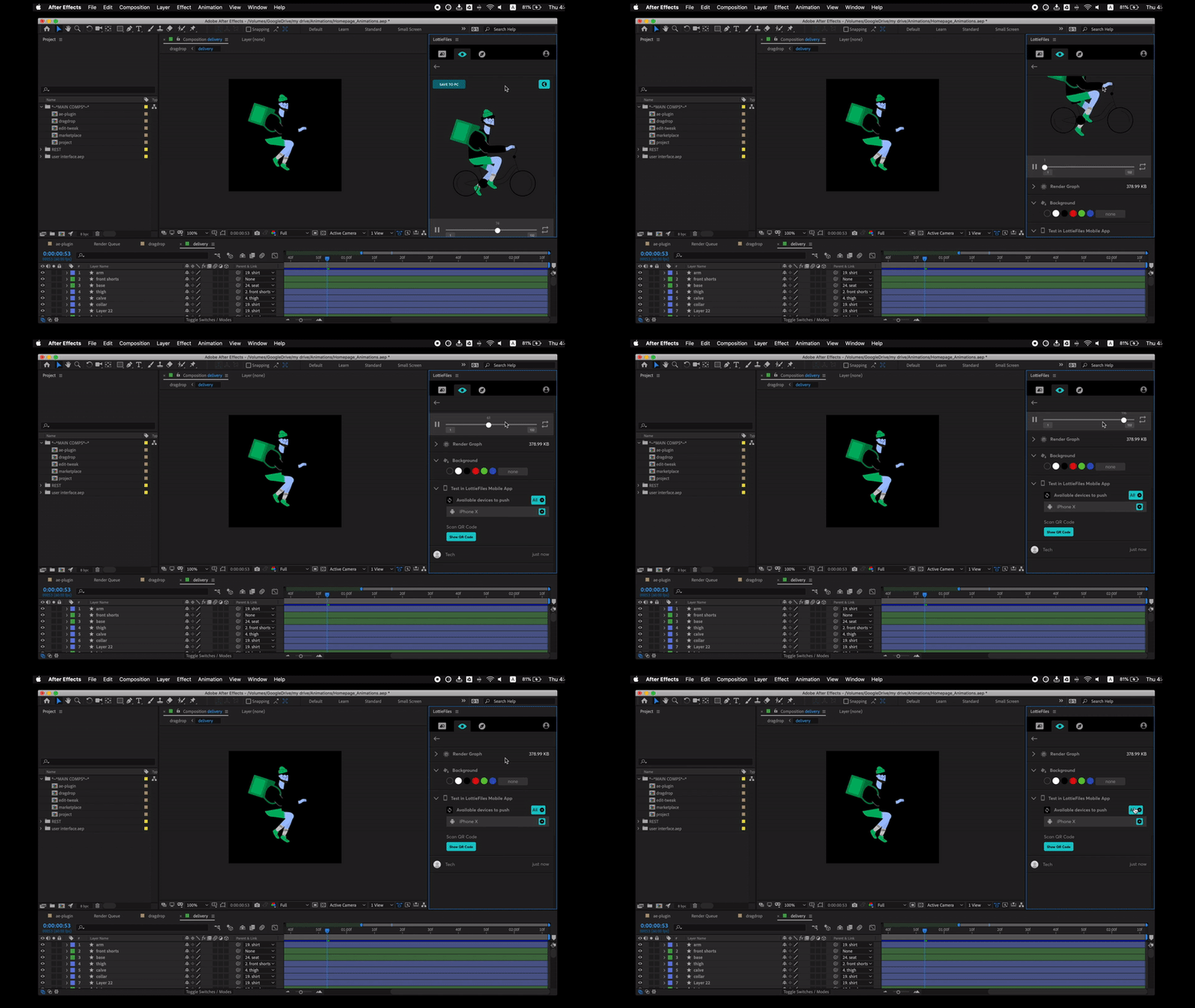
In 2017, they released Lottie, an open-source library that parses Adobe After Effects animations exported as JSON files with the Bodymovin plugin. Unlike Flash, Lottie does not require a proprietary plugin; it renders natively using the device’s existing framework (Core Animation on iOS, Canvas/SVG/HTML on Web).
Why Lottie is Technologically Superior
Lottie represents a shift from “Video as Content” to “Animation as Code.” Because a Lottie file is essentially a text-based JSON file, it offers advantages that neither Flash nor modern video formats can match:
- Resolution Independence: Since it is vector-based, a Lottie animation can be scaled to an 8K display or shrunk to a smartwatch icon without losing a single pixel of clarity.
- Dynamic Manipulation: Because it is code, developers can change colors, speeds, or triggers programmatically in real-time.
- Zero Latency: Lottie files load almost instantly, making them ideal for UI/UX elements like loading bars, button transitions, and headers.
The Technical Reality: Lottie vs. GIF vs. Video
Many entrepreneurs and marketers still rely on GIFs for web animation, unaware of the technical debt they are accumulating. From an SEO and performance standpoint, the GIF is an obsolete format that actively harms user retention and Core Web Vitals.
File Weight and Performance Comparison
Consider a standard 1080×1080 hero animation for a landing page.
- GIF: Often exceeds 5MB to 10MB to maintain decent quality. It is limited to a 256-color palette, resulting in “dithering” or grainy gradients.
- MP4/WebM: Can be compressed to 1MB, but requires significant CPU/GPU resources to decode and often lacks a transparent background.
- Lottie: Typically ranges between 20KB and 250KB.
| Feature | Lottie (JSON) | GIF | MP4/Video |
| Scalability | Infinite (Vector) | Fixed (Raster/Pixel) | Fixed (Raster/Pixel) |
| File Size | Extremely Small | Extremely Large | Medium |
| Transparency | Perfect Alpha Channel | Binary (Messy Edges) | Complex/Limited |
| Interactivity | High (Trigger-based) | None | None |
For a business owner, this isn’t just about aesthetics; it’s about conversion. A page that loads 3 seconds faster because it uses Lottie instead of heavy GIFs will naturally rank higher on Google and see lower bounce rates.
Reviving the Interactive Spirit: Beyond Play/Pause
The true legacy of Flash wasn’t just “moving pictures”; it was interactivity. We are seeing a renaissance of this spirit in modern web design. Lottie allows animators to create “smart” assets that react to user behavior.
Interactive Implementation Use-Cases:
- Scroll-Tied Animations: The animation progresses or reverses based on the user’s scroll position. This is excellent for storytelling and product reveals.
- Hover Triggers: Icons that react with personality when a user moves their cursor over them, providing immediate haptic-like visual feedback.
- State-Dependent UI: A “Purchase” button that transforms into a loading spinner and then a “Success” checkmark, all within a single, continuous vector file.
This level of fluidity was the hallmark of the 2000s web, and Lottie has finally provided the technical bridge to bring it back without the security risks of the past.
The Business Case for Lottie in Entrepreneurship
In a competitive market, “static” is synonymous with “forgettable.” Whether you are building a SaaS platform, an e-commerce store, or a digital agency, the quality of your motion design reflects the quality of your engineering.
High-fidelity animations build Trust (the ‘T’ in E-E-A-T). When a website functions with the smoothness of a high-end mobile app, the user perceives the brand as more professional and technologically advanced. Furthermore, the ability to use the same animation asset across a web dashboard, an iOS app, and an Android app significantly reduces development costs and ensures brand consistency.
Strategic Implementation
For those looking to integrate these advanced workflows, specialized expertise is required to bridge the gap between creative animation and functional code. At Muyano Studio, we focus on this exact intersection. By utilizing the latest Lottie workflows, we help brands move away from the limitations of traditional video and into the era of Interactive Animations.
Future Implications: AI and Automated Animation
Looking forward, the convergence of AI and Lottie is set to revolutionize the industry once again. We are entering a phase where AI can generate the underlying JSON paths for Lottie animations based on text prompts. This will allow for hyper-personalized user experiences where the UI animations could change based on user preferences or real-time data inputs.
However, the “soul” of the animation—the timing, the easing, and the artistic intent—still requires a human touch. Much like the early Flash pioneers who pushed the boundaries of what a browser could do, modern Lottie designers are the new architects of the digital experience.
Conclusion: The New Golden Age of Web Animation
The death of Flash was necessary for the web to grow, but the loss of its creative flexibility was a high price to pay. Lottie has effectively repaid that debt. By offering infinite resolution, minuscule file sizes, and deep interactivity, it has surpassed the legacy of Flash while adhering to the rigorous standards of the modern, secure, and mobile-first internet.
If you are still using GIFs for your banners, headers, or app transitions, you are operating with 20-year-old constraints. It is time to embrace the vector revolution and provide your users with the fluid, crisp, and interactive experiences they deserve.
Professional Note: To see how these principles are applied to real-world business scalability, explore our dedicated services inInteractive Motion Design. We don’t just animate; we optimize for the future of the web.