

The transition from generative AI to agentic AI marks a point of no return for modern enterprise.
We have moved beyond the “Chat” phase, where humans remained the primary drivers, into an era of autonomous agents capable of executing tasks, managing finances, and interacting with other software without human intervention. While the allure of zero-friction operations is powerful, it masks a systemic risk. Delegating decision-making power to an algorithm is not a simple efficiency play; it is an experiment in handing over the “Intentionality” of your business to a black box.
The Recursive Token Trap: The Real Cost of Autonomy
The most immediate, yet often overlooked, risk of AI agents is the economic structure of their reasoning. Unlike standard LLM interactions, agents operate in Recursive Reasoning Cycles. When an agent is tasked with a goal, it doesn’t just respond; it plans, reflects, uses tools, and re-evaluates.
- Computational Loops: Each “thought” or “action” by an agent consumes tokens. In a complex workflow—such as procurement or multi-platform marketing management—an agent may go through dozens of iterations to complete a single task.
- The Hallucination Overhead: If an agent encounters an error, its self-correction mechanism often triggers further recursive calls. This creates a “runaway token” scenario where a business can burn through thousands of dollars in API credits for a task that remains unfinished or executed incorrectly.
- Context Window Bloat: To maintain coherence across long tasks, agents must feed large portions of their history back into the LLM. This exponential increase in context size drives up latency and cost, often reaching a point where human labor would have been more cost-effective and accurate.
The “Wall-E” Syndrome: Seeking Inertia at the Expense of Agency
Humanity is currently chasing the “Wall-E” future: a state of total passivity where machines handle the friction of life. In a corporate environment, this translates to the pursuit of Zero-Touch Operations. However, business is essentially the management of friction. When we delegate the “doing” to an agent, we lose the Intuition Gap.
Business success often relies on the 1% of decisions that deviate from the norm—the creative risk, the ethical stand, or the pivot based on a subtle market vibe. An agent, by definition, operates on probability and historical data. By delegating too much, a company risks becoming a “Commodity Entity,” unable to innovate because its decision-making logic is identical to that of its competitors using the same models. We aren’t just saving time; we are outsourcing the very soul of the brand.
When Machines Buy from Machines: The M2M Sales Shift
The most radical shift is occurring in the sales funnel. We are entering the era of Machine-to-Machine (M2M) Commerce. When an AI agent is the decision-maker for a purchase, the traditional rules of marketing and sales are not just bent; they are broken.
The End of Narrative Persuasion
An AI agent does not care about your brand’s “Why.” It does not respond to emotional storytelling, color psychology, or celebrity endorsements. Its decision-making matrix is built on:
- Structured Data (JSON/Schema): Can the agent read your product specifications without ambiguity?
- API Accessibility: How easily can the agent execute the purchase and integrate it into its own workflow?
- Verifiable ROI Metrics: The agent looks for hard data points over “vibe-based” marketing.
In this paradigm, marketing becomes a technical discipline of Data Provisioning. If your brand is not “Machine Readable,” it is invisible. This creates a massive barrier for entry for creative-led brands and favors those with the most robust technical documentation.
The Rise of the Sponsored Agent
A critical ethical and strategic risk is the Incentive Bias inherent in the platforms providing these agents. If an agent is built by a major tech conglomerate, its “autonomous” decisions will inevitably be influenced by its creator’s ecosystem.
- Preferred Vendors: An agent might “decide” that a specific cloud service or software is the best choice because it is part of its parent company’s partnership network.
- The Algorithmic Kickback: We face a future where companies pay for “Agentic Priority,” ensuring that when a machine is looking for a solution, your product is the “logical” first choice presented in its reasoning chain.
The Creative Ecosystem: Reclaiming Human Authority
As the digital landscape becomes a sea of automated, data-heavy interactions, the premium on Human-Centric Creativity increases exponentially. To avoid being swallowed by the “Wall-E” economy, brands must double down on high-impact, intentional communication that machines cannot replicate.
This is where Gaston’s Creative Ecosystem acts as a strategic buffer. While AI agents handle the invisible plumbing of your business, you must invest in the visible architecture of your brand.
- Video Explainers: Complex AI-driven systems require human understanding. High-quality explainers bridge the gap between technical complexity and stakeholder buy-in.
- Marketing Games (HTML5): In a world of passive consumption and automated decisions, interactive games force “Active Engagement,” building the kind of brand loyalty an AI agent can’t quantify.
- Interactive Animations (Lottie): Ensure your UX/UI is lightweight and high-performance. An agent might find your site, but a human must still trust it. Fast, elegant animations signal professional authority.
- Coffee Comics: Use these for interactive manuals and training. When you delegate tasks to humans or machines, the instructions must be clear, engaging, and impossible to misinterpret.
To protect your brand’s essence while leveraging the power of automation, you need a partner that understands the balance between technical ROI and creative soul. Discover the path to high-impact results at studio.muyano.com.
The Labor Market: The Transition to “System Auditors”
Total delegation to AI agents doesn’t just eliminate jobs; it fundamentally alters the Value of Expertise. We are moving from a world of “Doers” to a world of “Auditors.”
The risk here is Skill Atrophy. If a junior marketer or developer relies entirely on an agent to execute tasks, they never develop the foundational knowledge required to identify when the agent is failing. This creates a fragile organization. If the AI “brain” experiences a service outage or a logic shift, the human staff lacks the “muscle memory” to step in.
Furthermore, access to top-tier agents will define the new social classes of business:
- The Sovereign Class: Large corporations that build private, unbiased, “unplugged” agents on proprietary hardware.
- The Dependent Class: Small to medium enterprises that use “Ad-Supported” agents, essentially letting Big Tech drive their business decisions in exchange for a lower API cost.
Conclusion: The Strategic Middle Ground
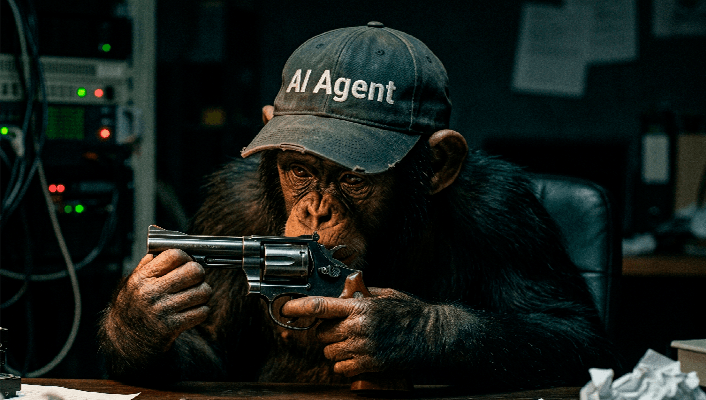
Is delegating to an AI agent a shot in the foot? Only if you surrender your Strategic Sovereignty.
The future belongs to the “Hybrid Leader”—the one who uses agents to handle the high-volume, low-stakes token-burning tasks, but maintains a relentless grip on the creative, ethical, and high-level strategic direction of the company. We must resist the urge to lie back on the sun-lounger of the Wall-E ship.
The costs—both financial (tokens) and existential (agency)—are too high to ignore. Use the agents as tools, but never as the architect. The goal of technology has always been to augment human potential, not to replace the need for it. If the decision is purely the machine’s, then the business is no longer yours.