The 8-bit era of the 1980s and early 1990s is often viewed through a lens of pixelated nostalgia.
However, for the software industry, it represented the Wild West of intellectual property (IP) exploitation. While titles like Super Mario Bros. and The Legend of Zelda were building the foundations of game design, a parallel industry was perfecting the art of the “Minimum Viable Product” (MVP) long before the term became a staple of Silicon Valley.
This was the era of the movie-licensed game—a phenomenon where marketing budgets eclipsed development resources, and technical limitations were weaponized to mask a lack of creative depth. By analyzing the business models of publishers like LJN and the technical constraints of the NES (Nintendo Entertainment System) architecture, we can see how these “nostalgic” disappointments were actually the result of calculated corporate strategies.
1. The Economics of the IP Trap: Fixed Costs and Rushed Pipelines
In the 1980s, the business of video games was dictated by the cost of physical distribution. Unlike today’s digital landscape, where a developer can patch a game post-launch, the 8-bit era required massive upfront investments in ROM cartridges.
The License-First Strategy
Publishers like LJN (a subsidiary of MCA/Universal) and Activision identified a lucrative loophole in consumer psychology. They realized that a recognizable IP—such as Back to the Future, Jaws, or Friday the 13th—acted as a powerful customer acquisition tool. The strategy was simple:
- Acquire the License: Secure the rights to a summer blockbuster.
- Minimize R&D: Outsource development to small teams with strict 3-to-6-month deadlines.
- Front-Load Marketing: Use the movie’s poster art for the box design to create a false sense of cinematic fidelity.
Because the licensing fees were exorbitant, publishers slashed the development budget to maintain profit margins. This created a “License-First” model where the game was treated as a secondary merchandising item, akin to a lunchbox or a t-shirt, rather than a software product.
2. Technical Limitations: The 6502 CPU and the PPU Bottleneck
To understand why games like Beetlejuice or Ghostbusters felt “broken,” one must look at the hardware. The NES was powered by the Ricoh 2A03, an 8-bit microprocessor based on the MOS Technology 6502. While capable, it had significant limitations in handling complex physics and large amounts of on-screen data.
Collision Detection and Physics Engines
Developing a bespoke physics engine for every movie license was economically unfeasible. Instead, developers often used “template” engines. This is why so many movie games felt like poorly executed clones of Super Mario Bros.
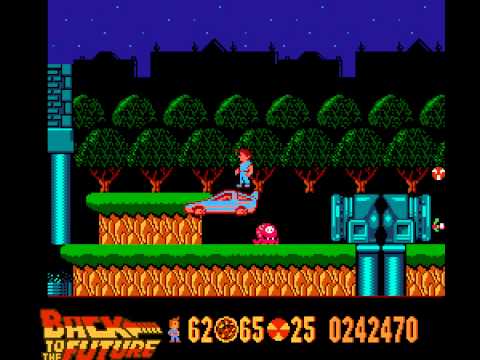
In the original Back to the Future (NES), developed by Beam Software, the player character (Marty McFly) moves at a jittery pace across a repetitive scrolling background. This was the result of suboptimal “hitbox” coding. When a sprite (Marty) overlaps with an enemy sprite (a hula-hooper), the CPU must calculate the intersection in real-time. To save clock cycles, developers used crude rectangular hitboxes that rarely aligned with the visual art, leading to the infamous “phantom deaths” that frustrated an entire generation.
The Sprite Budget and Flicker
The NES PPU (Picture Processing Unit) could only display eight sprites per horizontal scanline. If a movie game attempted to replicate a “cinematic” scene with multiple enemies—such as the ghosts in Ghostbusters—the hardware would struggle. This resulted in “sprite flickering,” a technical artifact where the hardware alternates the rendering of sprites to bypass the limit. For the player, this meant the protagonist would literally vanish during critical gameplay moments, breaking the immersion and the mechanical integrity of the game.
3. The Animation Deficit: Frame Budgets and Visual Inconsistency
From a technical animation perspective, the 8-bit era was a masterclass in compromise. Animators were working with a “tile-based” system. Each character was composed of 8×8 pixel tiles, and the total memory for animation frames was severely restricted by the ROM size (often as low as 24KB or 40KB in early titles).
Likeness Rights vs. Technical Reality
When a publisher puts Michael Keaton’s face on a box, the consumer expects to see Beetlejuice on the screen. However, on an 8-bit console, “Beetlejuice” is reduced to a 16×32 pixel cluster with a three-color palette.
In the Beetlejuice NES game, the animation cycles are stiff and lack “anticipation” and “follow-through”—two core principles of traditional animation. Because every frame of animation took up precious ROM space, developers would often limit a walk cycle to just two or three frames. This produced “staccato” movement that felt unresponsive to player input. Compare this to Prince of Persia (even in its 8-bit ports), which used rotoscoping to achieve fluid motion. The difference was that Prince of Persia was a tech-driven project, while Beetlejuice was a marketing-driven one.
4. Case Studies in Industrial Failure
Back to the Future: The Logic of Content Padding
The core loop of Back to the Future on the NES involved walking down a street collecting clocks to prevent a photograph from fading. This mechanic had no narrative tether to the film. It was a classic example of “content padding.” By making the game artificially difficult and repetitive, the developers ensured that a child could not finish the game within a single rental period. This was a deliberate business tactic to force “buy-ins” over rentals.
Ghostbusters: The Audio-Visual Loop
The Ghostbusters theme by Ray Parker Jr. is a masterpiece of pop marketing. In the NES version, a 15-second 8-bit loop of this theme plays throughout the entire game. This wasn’t just an artistic choice; it was a technical limitation. The NES audio chip (APU) had five channels. Maintaining a complex, evolving soundtrack while managing sound effects for proton packs and ghost captures required more memory than the publishers were willing to pay for. The result was a psychological “white noise” that turned a fun IP into a chore.
5. The 16-Bit Evolution: A Shift in Animation Pipelines
The transition to the 16-bit era (Super Nintendo and Sega Genesis) marked a paradigm shift in how movie licenses were handled. The hardware allowed for “DMA” (Direct Memory Access) and larger ROM capacities, which fundamentally changed the animation pipeline.
The Disney Standard
The 1990s saw the emergence of high-fidelity licensed games like Aladdin and The Lion King. Virgin Interactive and Capcom began collaborating directly with film animators. For Aladdin on the Genesis, developers used “Digicel” technology to compress hand-drawn animation frames into the game’s code.
For the first time, the “Business of the License” aligned with the “Technical Capability” of the hardware. The frames of animation increased from 2–3 per cycle to 10–12, providing the fluid, cinematic experience that the 8-bit era had only promised on its box art.
6. Modern Implications: From 8-Bit Deception to AI Generation
The history of 8-bit movie games serves as a cautionary tale for modern software development and entrepreneurship. Today, we see a similar trend in the mobile gaming market, where high-quality “CGI trailers” mask low-quality “Match-3” gameplay. The “Deception Model” has simply migrated to a different platform.
The Role of AI in Scaling Quality
In the current industry, AI and procedural generation are being used to solve the very problems that plagued 8-bit developers.
- Asset Generation: Where 8-bit animators struggled with tile limits, AI can now generate thousands of high-fidelity frames of animation in seconds.
- Physics Optimization: Modern engines like Unreal Engine 5 provide standardized, high-performance physics, eliminating the “phantom hitboxes” of the past.
However, the core business risk remains: IP Reliance. Even in 2026, many tech startups and game studios rely on “The License” to hide a lack of innovative mechanics. The “Nostalgia Deception” has evolved into a “Brand Deception,” where a famous name is used to drive engagement for a product that lacks technical or creative soul.
Conclusion
The 8-bit movie games of our childhood were not failures of imagination; they were successes of predatory business engineering. They proved that a strong brand could sell even the most technically flawed product. As we look forward to a future dominated by AI-driven content, the lesson of the 8-bit era is clear: Technical capability must be matched by ethical design.
For the entrepreneur and the developer, the goal should be to leverage the power of modern technology—not to repeat the “clon-of-Mario” shortcuts of the 80s, but to build experiences where the “Technical” and the “Emotional” finally align. The era of the 8-bit deception is over, but the battle for quality in licensed software is an ongoing technical challenge.