
The Illusion of Power: Visual Excellence vs. Mechanical Failure
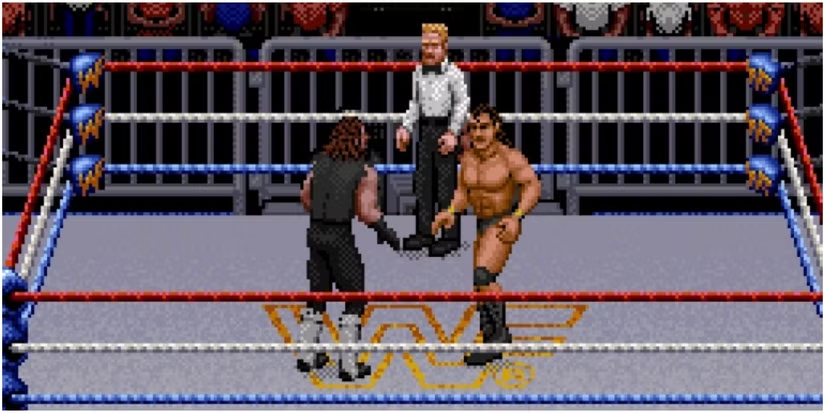
In the history of interactive entertainment, few genres have relied as heavily on “style over substance” as the wrestling game. During the late 1980s and early 1990s, wrestling titles were the crown jewels of arcades and home consoles. They offered a visceral, hyper-masculine spectacle that leveraged the era’s cutting-edge animation techniques to mask a fundamental truth: the core gameplay was often a technical disaster.
To understand the trajectory of sports entertainment software, we must look beyond the nostalgia. This is a case study in visual-first development, where marketing-driven aesthetics prioritized “the sell” over “the play.” From a business and animation perspective, the “Golden Age” of wrestling games represents a fascinating era of technical debt that the industry is still struggling to pay off.
The Foundational Architecture: 8-Bit Abstraction and the Birth of a Genre
The early 1980s were characterized by severe hardware constraints. On the Atari 2600, representing a human being—let alone a professional wrestler—required a massive leap of faith from the consumer. Developers were working with single-color blocks and minimal frame rates. However, the industry’s hunger for the “spectacle” of wrestling drove rapid experimentation.
Sega’s Champion Pro Wrestling (1985) for the SG-1000 began to define the spatial requirements of the ring. But it was Nintendo’s Pro Wrestling (1986) for the NES that established the blueprint for character-driven sports games. By introducing distinct personas like Starman and Fighter Hayabusa, Nintendo leveraged character design as a substitute for mechanical depth.
While the 8-bit sprites were colorful and the ring looked the part, the seed of the “Grapple” problem was planted here. Because collision detection was rudimentary, the game struggled to handle two character models occupying the same space. The solution was the “clinch”—a locked animation state that paused the action to allow the hardware to calculate the next move. This wasn’t a design choice; it was a technical compromise that would eventually become a genre-defining curse.
The Arcade Business Model: Monetizing Frustration Through Visuals
As we moved into the late 80s and early 90s, the battle shifted to the arcades. Companies like Technos Japan and Capcom realized that in a high-traffic environment, a game didn’t need to be fair; it needed to be loud and beautiful.
The Technos Era: WWF Superstars and WrestleFest
Technos Japan’s WWF Superstars (1989) and WWF WrestleFest (1991) were masterpieces of 2D animation. They utilized large, highly detailed sprites with saturated palettes that mirrored the neon-drenched aesthetic of the WWF’s “Rock ‘n’ Wrestling” era. For an entrepreneur in the arcade business, these machines were high-ROI assets. The visual fidelity acted as an “irresistible bait,” drawing players in with the promise of controlling their favorite TV heroes.
However, from a mechanical standpoint, WrestleFest was an exercise in opaque logic. The grapple system was designed as a “coin-eater.” There was no clear timing window or skill-based input. The CPU-controlled opponents operated on a hidden probability scale that favored the house. This was a deliberate monetization strategy: use world-class animation to hide a system that essentially cheated the player.
The Capcom and Midway Intersection
Capcom, the masters of the fighting game genre, attempted to fix the wrestling formula with Saturday Night Slam Masters (1993). By involving Tetsuo Hara (creator of Hokuto no Ken), they brought a level of anatomical detail and kinetic energy previously unseen. They attempted to blend Street Fighter mechanics with wrestling, but the “clinch” remained the bottleneck.
Midway took a different route with WWF WrestleMania: The Arcade Game (1995). Utilizing the same digitization technology as Mortal Kombat, they prioritized 60 FPS (frames per second) photorealism. While it was a technical marvel for its time, the game abandoned wrestling logic entirely in favor of a “fighting game” skin. It proved that the only way to escape the “clinch” was to stop being a wrestling game altogether.
The 16-Bit Console War: Bringing Technical Debt Home
The transition to the Sega Genesis and Super Nintendo (SNES) brought the arcade experience into the living room, but it also exposed the fragility of the “clinch” mechanic. Developers like Sculptured Software and publishers like LJN/Acclaim dominated this era with titles like WWF Royal Rumble and WWF Raw.
In the home market, the business model changed. You weren’t paying per play; you were paying $60 for a cartridge. Yet, the developers continued to use the “broken” arcade logic. This led to what we call “The Button-Mashing Era.”
The Physics of Mechanical Failure
The grapple system in these 16-bit titles was essentially a “dumb” resolution system. When two sprites collided, the game entered a state of rapid-fire input checking. The player who pressed buttons faster—or “mashed”—would win the grapple.
From a hardware durability perspective, this was a disaster. Thousands of controllers were ruined as players resorted to rubbing the buttons with coins or their knuckles to gain an advantage. This wasn’t “play”; it was an endurance test that ignored the strategic nuances of the sport it was trying to simulate. The inability of developers to create a sophisticated “lock-up” system for home consoles is a primary example of how early technical limitations can stifle genre innovation for decades.
The Grapple “Cringe”: Why the Mechanic Refuses to Die
If we look at the contemporary landscape, specifically the WWE 2K franchise, we see a disturbing trend. We have achieved graphical parity with television broadcasts. Sub-surface scattering mimics sweat on skin; motion capture provides 1:1 translations of real-world movements. And yet, the “clinch” remains the weakest link in the chain.
Modern Technical Patches
Today’s developers have attempted to “fix” the grapple by adding UI layers:
- Timed Meters: Forcing the player to hit a specific window.
- Circular Fill Gauges: Requiring a rhythmic hold.
- Rock-Paper-Scissors Systems: Adding a layer of random probability to the outcome.
None of these solutions address the core issue: the grapple breaks the flow of combat. In an era where AI can simulate complex physics in real-time, wrestling games still rely on “canned” animations that lock the players into a two-person interaction that ignores the rest of the environment. This is the “Legacy Code” of Game Design. Developers are so afraid of deviating from the established formula—or are so constrained by the annual release cycle—that they refuse to rebuild the engine from the ground up to support a more fluid, physics-based grappling system.
The Entrepreneurial and Animation Lesson
For those in the tech and animation industry, the history of wrestling games serves as a cautionary tale. It proves that visual fidelity is a depreciating asset. A game that looks incredible today will look dated in five years, but a game with broken mechanics is broken forever.
- Prioritize Core Loops: The “Grapple” was a failure of the core loop. No amount of high-fidelity texture work could fix a system that wasn’t fun to play.
- Scalability over Flash: Early developers prioritized flashy sprites over scalable physics. When hardware improved, they didn’t know how to move past the “sprite-lock” mentality.
- The Consumer Trust Gap: By selling “smoke and mirrors” for decades, the genre eventually alienated its core audience, leading to the massive volatility seen in wrestling game sales over the last decade.
Conclusion: A Beautiful Torture
The Golden Age of wrestling games was a period of immense creativity and visual wonder. It pushed the limits of what 8-bit and 16-bit hardware could do, creating iconic memories for millions of players. However, we must be honest about the product. These games were beautiful to look at but a torture to play.
The “Pesadilla de los Agarres” (the nightmare of the grapples) was not just a minor flaw; it was a systemic failure of design that privileged the “look” of wrestling over the “feel” of control. As we move further into the era of AI-driven animation and procedural physics, the industry must finally let go of the 1980s clinch and invent a new way for digital athletes to interact. Until then, wrestling games will remain a stunning spectacle trapped inside a broken machine.