

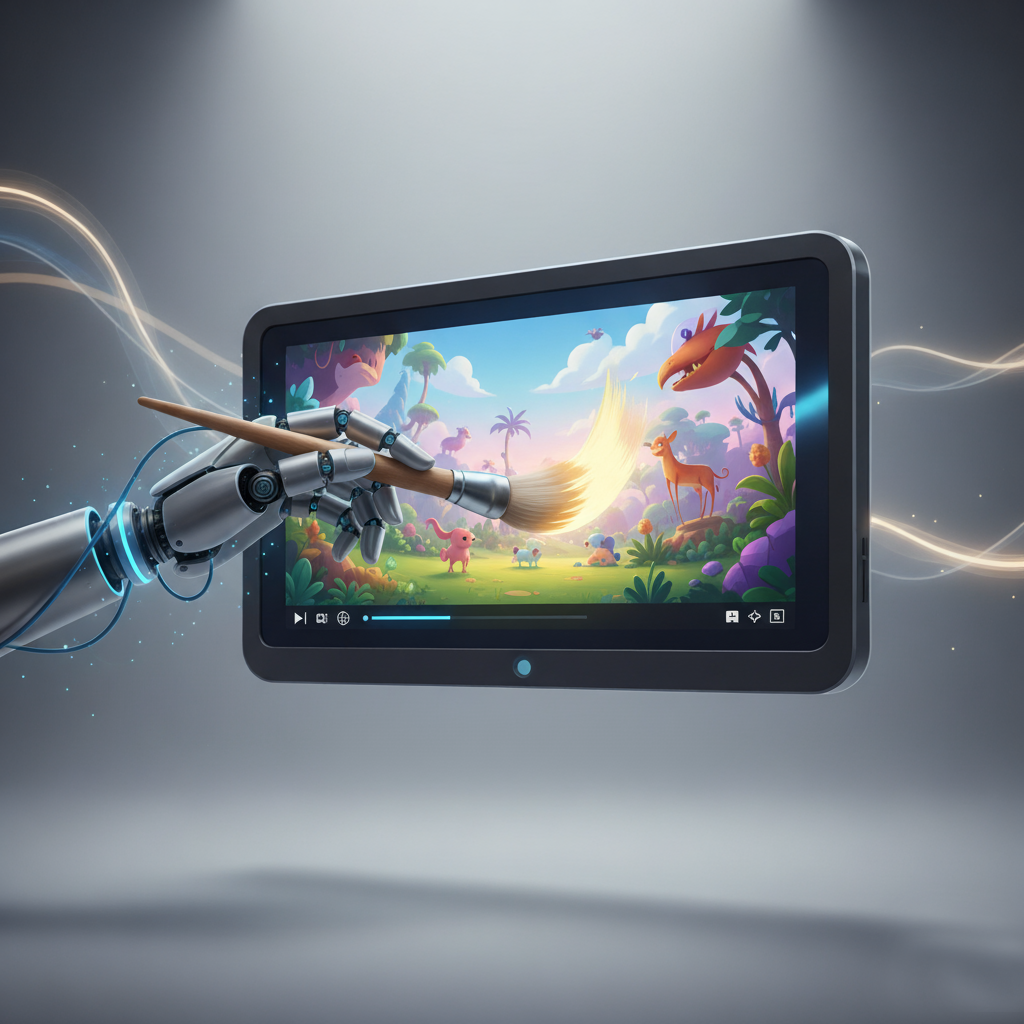
Why AI Isn’t the Apocalypse
Why Coca-Cola’s Ad Made Us Nervous
Coca-Cola’s new Christmas campaign landed like a bombshell in the industry. Made (almost) entirely with generative AI, it has unleashed a wave of anxiety. On social media and in virtual cafés, the question is the same: is this the beginning of the end for animators, illustrators, and designers?
As a professional who experiments with these models daily, my answer is a resounding “no.” But it’s a “no” with nuances.
The foam is at its highest level. YouTube headlines, designed to capture clickbait, are screaming “THEY’RE TAKING OUR JOBS!” or “THE WORLD OF ANIMATION IS OVER!”
But the reality, far from the panic, is much more interesting.
AI Isn’t an Autopilot, It’s a Co-Pilot
The first thing to understand is what generative AI is today. It is not an idea creator. It has no intention, no taste, and no personality. It is an incredibly powerful synthesis engine, an assistant that doesn’t sleep.
In my day-to-day work, I still see it for what it is: a tool. One that allows us to optimize production times in ways that were previously unthinkable and, above all, to elevate the quality of our deliverables.
Many fear that the end client will now do everything themselves. Let’s be honest: can anyone imagine a marketing manager, after a marathon day of meetings, sitting down to “prompt” their company’s next ad? I don’t think so. Everyone sticks to what they do best. The business owner needs a result, not to learn a new tool every six months.
The Bar Has Just Been Raised (And That’s a Good Thing)
What is undeniable is this: the quality bar has been raised.
Easy, repetitive, or generic work is indeed in danger. What used to take a week of basic motion graphics can now be prototyped in an afternoon. But this isn’t new. The arrival of Photoshop didn’t eliminate illustrators; it eliminated those who didn’t want to adapt. 3D didn’t kill 2D; it gave it new dimensions.
AI won’t take our jobs; an artist who knows how to use AI better than us will.
Our industry isn’t dying; it’s being filtered.
The Artist as a “Luxury Differentiator”
Here is the core of the issue. If AI can generate beautiful images and fluid animations, where does our value lie?
It lies exactly where it always has: in the differentiator.
AI can create almost anything, but it does so “in pieces.” It doesn’t understand harmony. It doesn’t know narrative. It cannot unify a concept, a color palette, an audio design, and an edit into a coherent whole that generates a specific emotion.
Our job is evolving. It’s no longer just about the technical skill of moving a keyframe, but about:
- Art Direction: Knowing what to ask for, how to ask for it, and, most importantly, how to curate and discard what the AI generates.
- Personality: Imprinting a unique style, a distinct voice that no machine can replicate. The value is in the signature.
- Post-Production and Editing: The work of integrating these generated pieces, working over them, correcting them, and giving them a professional finish.
- Strategy: Understanding the client and the audience, and using the tool to achieve a communication goal, not just a “pretty picture.”
In this new paradigm, our services must be sold as a differentiator. As a justified “luxury.” The client doesn’t pay for the tool we use; they pay for our vision, our taste, and our ability to execute that vision seamlessly.
Conclusion: Let’s Drop the Alarmism and Embrace Adaptation
AI is here, and it’s a reality. We can get nervous and sell alarmist articles, or we can do what we’ve always done: adapt.
No, AI is not the end of the animation world. It’s the end of one way of doing animation.
The real battle is not against the machine; it’s against irrelevance. The future belongs to the artists who know how to conduct the orchestra, not to those who cling to a single instrument.