

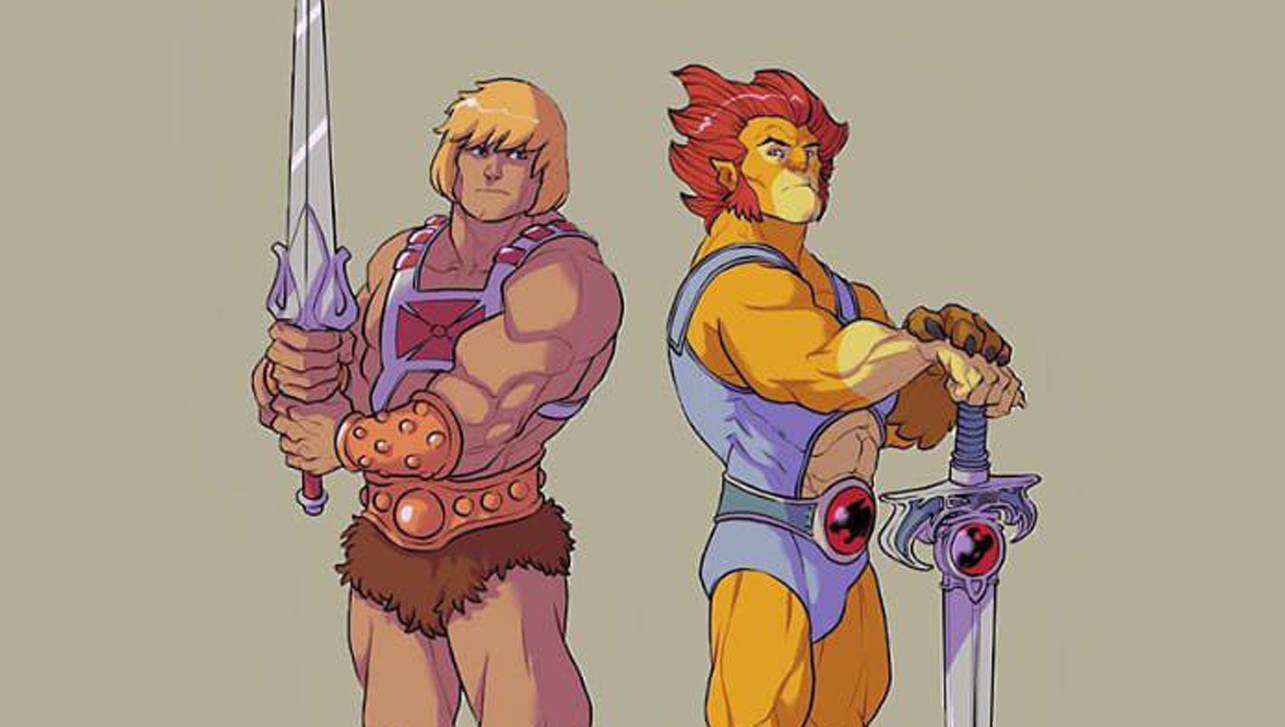
Why He-Man and Thundercats Are So Similar
And How the Battle Ended
If you grew up in the 1980s, you’ve almost certainly asked this question: Why do He-Man and the Masters of the Universe and Thundercats feel so… similar? Were they from the same creator? A ripoff? The answer is simpler and more fascinating: they weren’t family; they were the two primary competitors in a “formula war” that defined the decade’s animation.
This is the story of how a successful formula was created, copied, perfected, and ultimately pushed to its limits by two rival studios: Filmation and Rankin/Bass.
1. Patient Zero: He-Man and the Formula (1983)
It all started in 1983 with He-Man and the Masters of the Universe. The studio Filmation, in partnership with the toy company Mattel, didn’t just create a cartoon; they created a business model.
The goal was simple: create a 30-minute sci-fi fantasy show that served as a perfect commercial for a line of action figures. To achieve this, they established a formula that would become ubiquitous:
- The Hero: A young man (Prince Adam) who transforms into a super-powered warrior (He-Man).
- The Magic Sword: The catalyst for the transformation (The Sword of Power).
- The Mystical Fortress: The objective of the plot (Castle Grayskull).
- The Main Villain: An evil, deformed sorcerer (Skeletor) who covets the fortress’s power.
- The Lairs: Clearly defined good vs. evil headquarters (Grayskull vs. Snake Mountain).
- The Comic Relief: A small, annoying mascot or sidekick (Orko).
- The Team: A cast of secondary characters with unique abilities (Man-At-Arms, Teela, etc.), each ready to be an action figure.
He-Man was a runaway success. And when something is successful, the competition takes notes.
2. The Perfectionist Challenger: Thundercats (1985)
Almost a year and a half later, in January 1985, Thundercats appeared. This series was not from Filmation, but from its main competitor, Rankin/Bass (which partnered with the toy company LJN).
Thundercats didn’t try to hide that it was following the He-Man formula. It simply took it and, in many respects, perfected it with a bigger animation budget (often with anime influences) and a more epic origin story.
The structure was a near-perfect match:
| Formula Archetype | He-Man (The Original) | Thundercats (The Competitor) |
| Main Hero | Prince Adam / He-Man | Lion-O (Youth in an adult body) |
| Magic Sword | Sword of Power (Transforms) | Sword of Omens (Gives sight / Summons) |
| Fortress of Good | Castle Grayskull | The Cat’s Lair |
| Main Villain | Skeletor (Skull sorcerer) | Mumm-Ra (Mummified sorcerer) |
| Lair of Evil | Snake Mountain | The Black Pyramid |
| Comic Relief | Orko (Floating mage) | Snarf (Whiny cat-nanny) |
| The Team | The Masters of the Universe | The Thundercats (Tygra, Cheetara, Panthro) |
So, no, they weren’t related. They were the two rival kings fighting for the same throne.
3. The Second Round: Cowboys vs. Space Hawks (1986-1987)
The war didn’t end there. Both studios needed their next big hit, which brings us to the second wave of shows many remember.
SilverHawks (1986)
The Rankin/Bass studio, emboldened by the success of Thundercats, applied its own philosophy: “if it works, repeat it.” In 1986, they released SilverHawks.
They weren’t copying He-Man this time; they were copying themselves. SilverHawks was, in essence, “Thundercats in space.” They swapped epic fantasy for space opera and felines for bionic hawks, but the team structure, the leader (Quicksilver), and the monstrous villain (Mon*Star) were identical.
BraveStarr (1987)
Meanwhile, Filmation (the creators of He-Man) watched as their original formula was imitated. For their next big project, they decided to innovate and create an entirely new genre: the “Space Western.”
In 1987, they launched BraveStarr. This series was much more original: a Native American marshall on a desert planet (New Texas) who drew powers from spirit animals (Strength of the Bear, Eyes of the Hawk). His partner was a talking cyborg-horse named Thirty/Thirty.
This is where the shows feel “more different,” because Filmation was trying to escape the very formula they had created, while Rankin/Bass was exploiting it to the fullest.
4. Twilight of the Masters: The Fall of Filmation (1989)
Unfortunately for the pioneering studio, the competition was too much. BraveStarr (1987) was Filmation’s last great battle, and they lost.
That same year, two catastrophic events sealed the studio’s fate:
- The Failure of BieStar: The series was creative, but neither the cartoon nor the toys managed to connect with the public.
- The Failure of the He-Man Movie: The live-action Masters of the Universe film (starring Dolph Lundgren) was a critical and box-office disaster, killing the franchise that was keeping the studio alive.
Furthermore, the market had become saturated. It was no longer just the two of them. They were now competing against giants like Transformers, G.I. Joe, and the final blow, Teenage Mutant Ninja Turtles (1987).
In 1989, Filmation was sold, and the new owner shut down the animation studio overnight, ending an era. The creator of the formula could not survive the war it had started.