

From Tom and Jerry to The Flintstones: The Invention of Limited Animation That Dominated TV
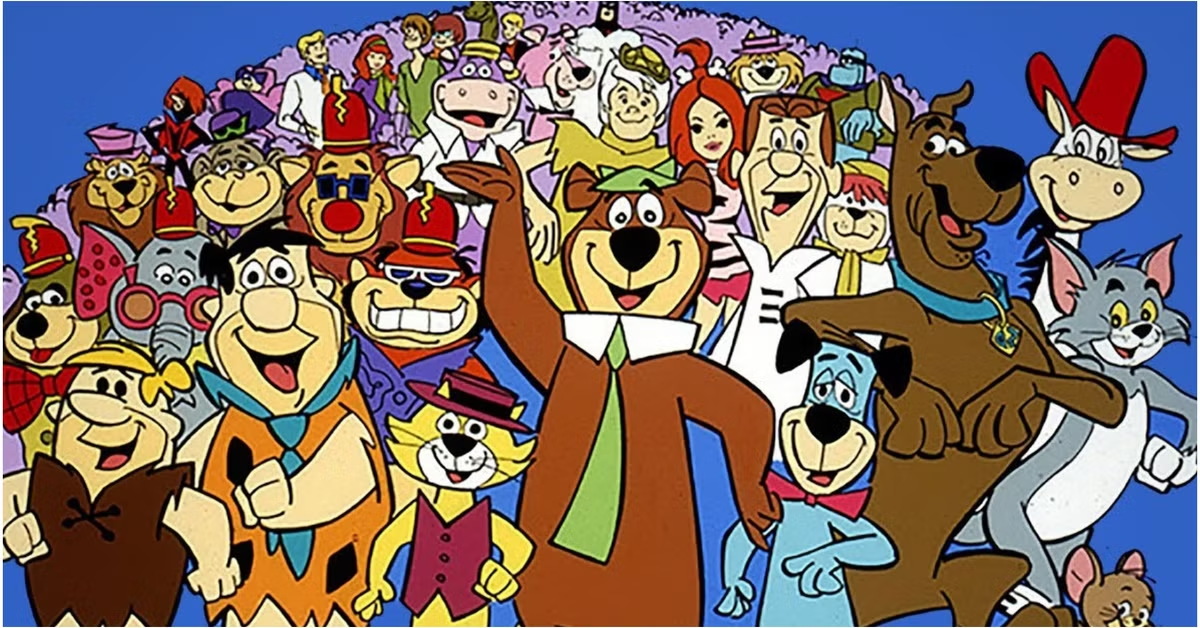
If you grew up watching television in the last six decades, your childhood was almost certainly shaped by two men: William Hanna and Joseph Barbera. From The Flintstones to Scooby-Doo, and Top Cat to The Jetsons, their studio wasn’t just prolific; it was hegemonic.
But how did they do it? It wasn’t just with endearing characters. It was with a revolutionary production strategy and a “shark mentality” for business.
1. The Crisis: The End of an Era (and the Birth of an Opportunity)
To understand H-B’s success, you must first understand their failure. Or rather, the failure of the system that birthed them.
Bill Hanna and Joe Barbera were the star directors in MGM’s animation department. Their creation? Tom and Jerry. Every Tom and Jerry short was a masterpiece: fluid, detailed animation with incredibly complex visual gags. As you mentioned, it was “all action.”
But it had a problem: it was incredibly expensive and slow. Each 7-minute short could cost the equivalent of hundreds of thousands of today’s dollars and take months to produce. When television disrupted the industry and film studios shut down their animation divisions in the 1950s, Hanna and Barbera found themselves out of a job.
Theatrical animation was dead. TV animation was a new territory, with minuscule budgets and a voracious need for fast content.
2. The “Shark Mentality”: The Engineering of Limited Animation
This is where the “shark mentality” comes in. H-B understood they couldn’t bring the quality of Tom and Jerry to TV. It was impossible. Instead of trying to adapt the old model, they created a new one.
This system is known as “Limited Animation,” and it was the key to their empire.
Your point about a “pre-made system” is exactly this. They reduced the animation process to its most basic, efficient components:
- Static Backgrounds: Why draw a new background for every frame? They created one “already-generated frame” and reused it over and over. If characters were walking, it was often the background that moved on a loop behind them.
- Partial Animation: Instead of redrawing the entire character, they only animated what was strictly necessary: the mouth when talking, an arm when pointing, the eyes when blinking.
- The Collar Trick: Why do Fred Flintstone and Yogi Bear wear ties or collars? It wasn’t fashion! It was a production trick. It allowed the head to be separated from the body, meaning they could animate just the head (with a limited number of drawings) on a static body, saving thousands of drawings.
- Fewer Drawings Per Second: Instead of 24 frames per second (film), they often used 12, 8, or even fewer, reusing the same drawing for multiple frames.
This “streamlined production” to a level never seen before. An episode that would have taken MGM months, H-B could do in weeks, or even days.
3. The Pillar of Success: “More Talkative Scripts”
Here is the other half of the genius. If the animation was going to be simple, the narrative had to be strong.
H-B shifted the focus from slapstick (the visual gags of Tom and Jerry) to the sitcom (the situation comedy).
The Flintstones isn’t an action cartoon; it’s The Honeymooners (a popular comedy of the era) in the Stone Age. The center of the episode wasn’t an elaborate chase; it was “family problems where conversations were central,” as you correctly stated.
This was a masterstroke for two reasons:
- It Was Cheap: Animating two characters talking is infinitely cheaper and faster than animating a chaotic chase.
- It Was Addictive: People got hooked on the stories. The Flintstones dealt with their boss, their mother-in-law, and neighborly problems. They were characters the audience could empathize with, week after week.
The scripts, witty dialogue, and well-defined personalities were now the engine of entertainment, not the fluidity of the animation.
4. The Empire and the Eternal Legacy
This formula (Limited Animation + Sitcom Scripts) allowed Hanna-Barbera to completely dominate. They became a hit factory. While other studios struggled to produce one pilot, H-B already had three new series on the air.
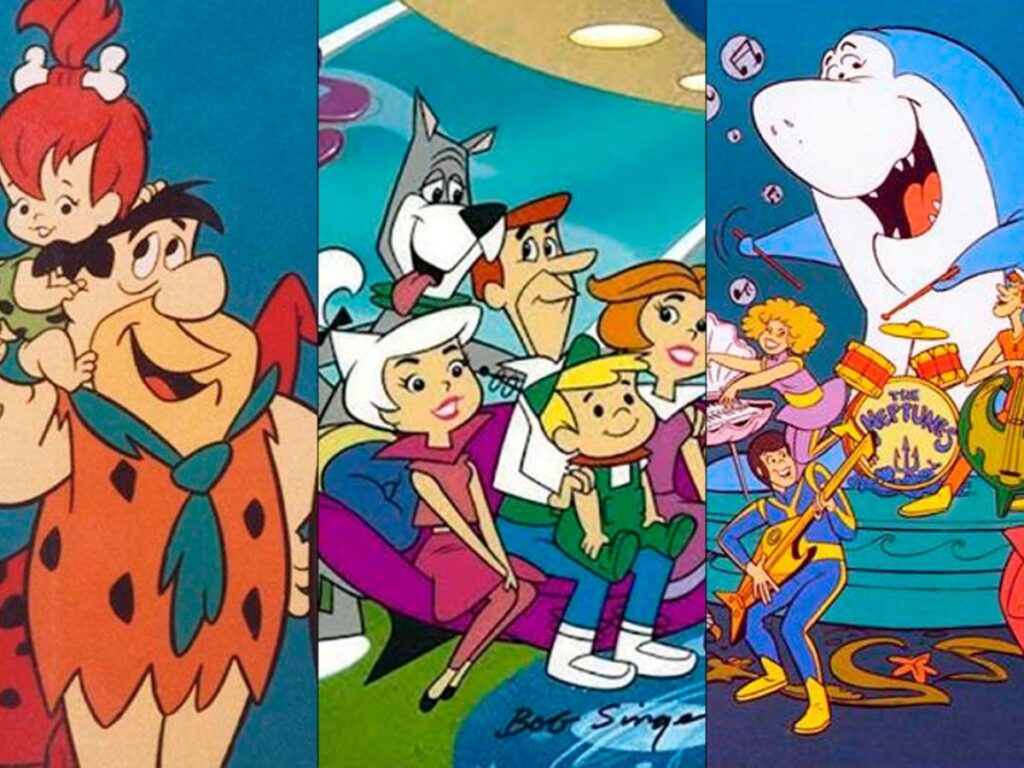
They flooded the 60s, 70s, and 80s with intellectual properties. The Jetsons, Top Cat, Scooby-Doo, Wacky Races, Yogi Bear, The Smurfs… the list is endless.
And that is their final legacy: the characters. By focusing on narrative and personality, they created icons. These characters were so strong that they transcended their simple animation.
Today, decades later, that company “on the verge of bankruptcy” (or rather, those two laid-off animators) continues to generate millions. The characters born from the need to cut costs now star in billion-dollar films, streaming series, and, of course, continue to sell “t-shirts, toys, and more.”
Hanna-Barbera didn’t just create cartoons; they created a business model that defined television for 40 years.